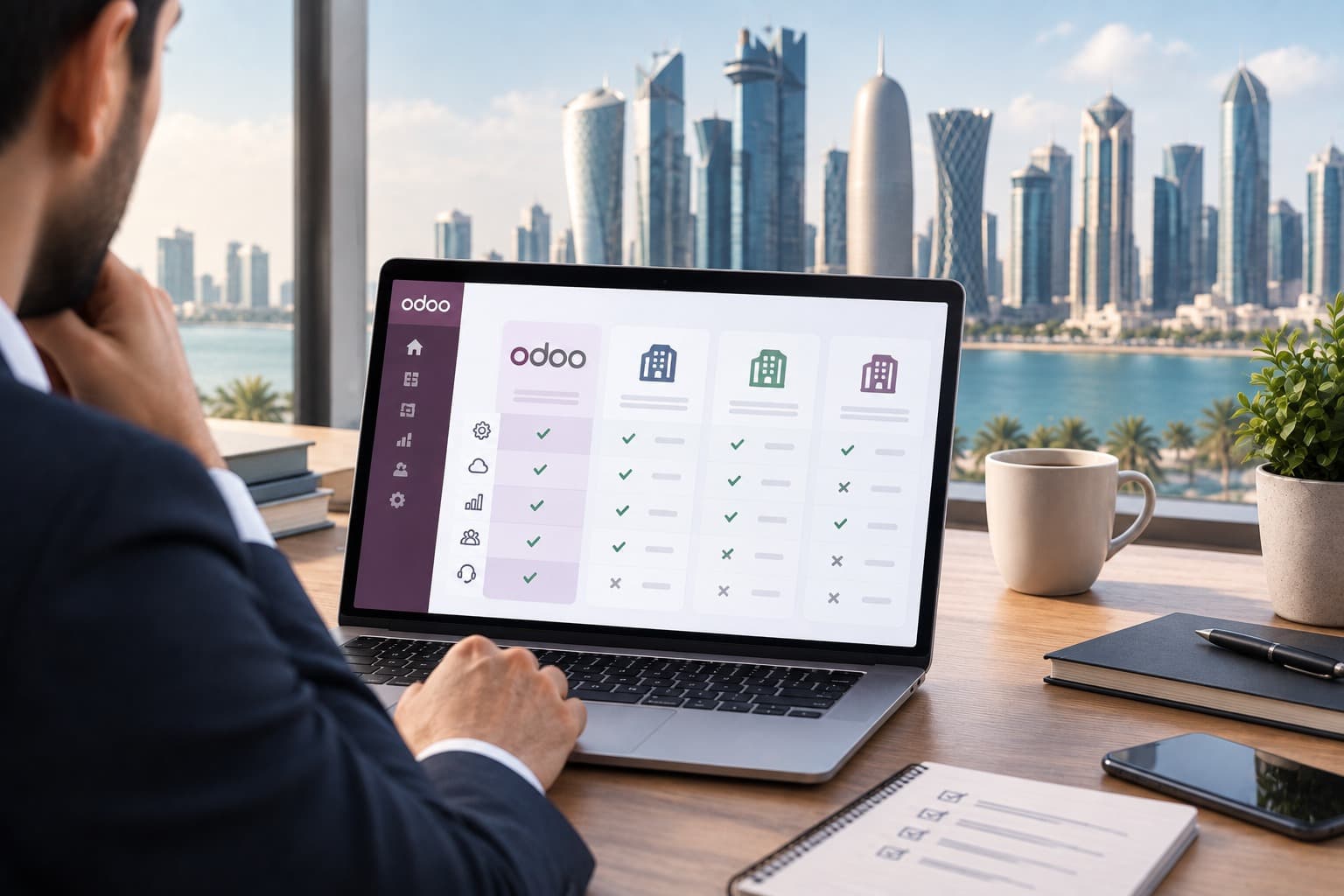
Qatar's businesses are scaling faster than the spreadsheets and disconnected apps they started on can keep up with. Somewhere between the second office, the third project, or the tenth new SKU, the sa...
Qatar's businesses are scaling faster than the spreadsheets and disconnected apps they started on can keep up with. Somewhere between the second office, the third project, or the tenth new SKU, the same problem shows up: nobody has a single, trustworthy view of what's actually happening in the business. That's usually the point a company starts searching for ERP software in Qatar, and just as quickly runs into two questions that don't have a simple answer — what does it cost, and how do you actually choose the right one?
This guide answers both, without the vendor-brochure spin.
What Is ERP Software, in Practical Terms?
ERP software in Qatar connects the systems a business already runs on — sales, inventory, purchasing, accounting, HR, projects — into one shared database instead of five disconnected tools that don't talk to each other. Instead of a sales order living in one app, stock levels in a spreadsheet, and invoices in a separate accounting tool, everything updates in the same place, in real time.
For a growing business, that shift changes how decisions get made. A manager isn't waiting on someone to export a report; the numbers are already there, current, and consistent across departments.
What Does ERP Software Cost in Qatar?
This is the question most comparison articles avoid, mainly because there's no single number that applies to every business. Cost depends on a handful of variables, and understanding them is more useful than any flat price tag:
1. Number of users and modules A five-person trading company using Sales, Purchase, and Accounting pays for a very different footprint than a 50-person contractor running Project, Procurement, Inventory, and HR together. Licensing and implementation scale with what's actually being used, not a fixed package.
2. Level of customization Out-of-the-box configuration costs less than a system rebuilt around specific approval chains, custom reports, or industry-specific workflows like BOQ tracking or multi-branch inventory. The more a system needs to match how a business already operates, the more implementation work goes into it.
3. Data migration complexity Moving five years of accounting history and vendor records out of legacy spreadsheets or an old system is a very different job than starting fresh. Clean, well-structured existing data brings costs down; scattered records across multiple tools push them up.
4. Integrations Connecting ERP software in Qatar to a company's existing website, payment gateway, WhatsApp Business, or a supplier's system adds development time — but it also tends to be where a lot of the day-to-day time savings come from.
5. Training and support A system nobody knows how to use properly gets abandoned within a year. Ongoing support and training (AMC) is usually priced separately from the initial implementation and is one of the areas businesses most regret cutting to save money upfront.
The honest answer to "what does it cost" is: it depends on scope, not on the software brand. This is exactly why AGM structures every engagement around a consultation first — mapping modules, users, and workflows — rather than quoting a number before understanding the business.
Cost Driver | Low Impact | High Impact |
Users & modules | Few users, 2-3 core modules | Large team, full suite across departments |
Customization | Standard configuration | Industry-specific workflows, custom reports |
Data migration | Clean, centralized data | Scattered legacy records, multiple sources |
Integrations | Standalone system | Connected to website, payments, third-party apps |
Support | Self-managed post go-live | Ongoing AMC, training, optimization |
How to Choose the Right ERP Software in Qatar
Cost is only half the decision. The other half is fit — and this is where most businesses get it wrong, usually by picking a system based on brand recognition rather than whether it actually matches how they operate.
1. Start With the Problem, Not the Software
Before comparing platforms, get specific about what's actually breaking today. Is it delayed billing? Stock discrepancies between sites? No visibility into project profitability until month-end? The clearest ERP decisions come from businesses that can name the problem in one sentence — not from businesses that started by asking "what's the best ERP software in Qatar."
2. Modular Beats Rigid
A system that forces a company to pay for and configure modules it doesn't need adds cost without adding value. Modular platforms like Odoo let a business start with core functions — Sales, Inventory, Accounting — and add Project, Manufacturing, or CRM as it grows, without a system overhaul later.
3. Local Compliance Isn't Optional
ERP software in Qatar needs to handle local realities: VAT-ready invoicing, WPS-compliant payroll, and bilingual (Arabic and English) documentation for contracts and audits. A system built for a different market and adapted after the fact often misses details that only show up during an audit.
4. Evaluate the Implementation Partner, Not Just the Platform
The software is one part of the decision; who configures it is the other. Two businesses running the same ERP platform can have completely different outcomes depending on whether the implementation partner understood their industry workflows or applied a generic template. Ask a potential partner:
- Have they implemented for businesses in this specific industry before?
- What does their phased rollout actually look like?
- What happens after go-live — is support ongoing, or does it end at handover?
5. Plan for the Next Phase, Not Just Go-Live
The businesses that get the most out of ERP software in Qatar treat it as a journey, not a one-time project. Phase one is operational stability — accurate data, standard processes, a system the team trusts. Phase two is optimization — dashboards, automated approvals, KPI tracking. Phase three is running the business on intelligence rather than manual supervision. Choosing a system (and a partner) that can support all three phases avoids a second migration two years down the line.
Why Odoo Is a Practical Starting Point
Odoo's modular structure is one of the reasons it's become a common choice for ERP software in Qatar across construction, trading, manufacturing, restaurant chains, and van sales operations. Because every module — Sales, Purchase, Inventory, Accounting, Project, CRM — shares one database, information entered once updates everywhere else automatically. A purchase order raised for a project reflects instantly in that project's cost tracking, with no manual reconciliation between systems.
That connected structure is also what makes cost more predictable over time: businesses aren't paying to maintain integrations between separate tools, because there's only one system to begin with.
Final Thoughts
There's no universal price tag for ERP software in Qatar, and any article that gives you one flat number is skipping the part that actually determines cost — scope, customization, and the complexity of what's being connected. The businesses that get real value out of an ERP investment are the ones that start with a clear problem, choose a modular platform that can grow with them, and pick an implementation partner who understands their industry rather than applying a one-size-fits-all setup.
If a business runs on people's memory and personal spreadsheets today, that's usually the sign it's time for the conversation — not the software purchase itself.
Frequently Asked Questions
1. How much does ERP software cost in Qatar? Cost depends on the number of users, modules needed, level of customization, data migration complexity, and ongoing support requirements. There's no fixed price — it's scoped per business during a consultation.
2. Is ERP software worth it for a small business in Qatar? Yes, particularly for businesses managing multiple locations, projects, or growing transaction volumes. Modular platforms like Odoo let small businesses start with core modules and add more as they scale, keeping initial cost aligned with actual need.
3. What's the difference between ERP software and accounting software? Accounting software manages financial records in isolation. ERP software in Qatar connects accounting with sales, inventory, procurement, and operations in one system, so financial data reflects real-time business activity instead of being updated separately.
4. How long does ERP implementation take in Qatar? It depends on scope. A focused implementation with a few core modules can go live in a matter of weeks; multi-department or industry-specific rollouts (like construction) take longer, with the timeline defined during consultation.
5. Does ERP software in Qatar support VAT and WPS compliance? A properly configured ERP system should handle VAT-ready invoicing and WPS-compliant payroll processing, along with bilingual Arabic-English documentation for audits and contracts — this is worth confirming directly with any implementation partner before signing.
Ready to see this in your business?
Book a free demo and we'll show you exactly how AGM runs it on Odoo.